Loyalty Without Points
How Ultra-Luxury Hotel Groups Build Guest Devotion Without a Rewards Program
A Comparative Analysis of Auberge Resorts Collection, Aman Resorts, Four Seasons Hotels & Resorts, Rosewood Hotels & Resorts, Mandarin Oriental, and Belmond
Executive Summary
The six luxury hotel groups examined in this white paper — Auberge Resorts Collection, Aman Resorts, Four Seasons Hotels & Resorts, Rosewood Hotels & Resorts, Mandarin Oriental, and Belmond — collectively represent the most rarefied tier of global hospitality. With average nightly rates well above $1,000 and properties that define the word 'iconic', these brands face a challenge that their mainstream counterparts solved decades ago with points and tiers: how do you keep your most valuable guests coming back?
The answer, almost unanimously, is that they don't use traditional loyalty programs. Instead, this segment has coalesced around a different paradigm — one built on personal recognition, experiential rewards, and an advisor-mediated preferred partner ecosystem that delivers tangible perks without the transactional feel of points accumulation.
Yet even within this shared philosophy, meaningful differences exist. Mandarin Oriental stands alone as the only brand with a formal, publicly available tiered guest recognition program, recently relaunched with invitation-only communities. Belmond uniquely extends its loyalty mechanics to legendary trains, river cruises, and safaris — an advantage no purely hotel-based competitor can match. Aman has elevated the absence of a loyalty program into a brand statement, with its devoted 'Aman Junkie' community functioning as the world's most organic loyalty ecosystem. Four Seasons and Rosewood both rely heavily on advisor-mediated preferred partner programs that deliver near-identical tangible benefits. And Auberge, the smallest portfolio, has yet to launch any brand-level recognition architecture.
This white paper analyzes each brand's approach, compares their loyalty mechanisms across eight key dimensions, and draws broader conclusions about why luxury loyalty is fundamentally different from the transactional points-and-tiers models that define mainstream hotel chains.
Section 1: Brand Introductions and Positioning
Before examining loyalty programs, it is worth understanding how each brand positions itself in the competitive luxury hospitality landscape. These are not interchangeable luxury labels — each has a distinct origin story, design philosophy, and target guest profile that directly shapes its approach to guest retention.
1.1 Auberge Resorts Collection
Founded in Napa Valley and still deeply American in its DNA, Auberge Resorts Collection has grown to approximately 30 independent, independently-spirited properties across the Americas and Europe. The brand's defining philosophy is what it calls 'fierce independence' — each property is designed to feel like a singular place with its own character rather than a recognizable chain hotel. Auberge has deliberately avoided the consolidation and standardization that characterizes larger luxury groups.
Properties span wine country retreats (Auberge du Soleil, Solage Calistoga), Hawaiian coastal resorts (Mauna Lani), mountain hideaways in Colorado and Utah, and expanding European outposts in Santorini and Geneva. New openings through 2025-2026 include properties in Florence, Dallas, and Shell Bay, Florida. The brand targets affluent American leisure travelers seeking authentic, place-rooted experiences over global brand consistency.
Auberge's differentiation lies in its culinary programming, curated 'Auberge Adventures' experiences, and the distinctive architectural and design vocabulary each property maintains. It competes most directly against other boutique collection brands like Oetker Collection, but is rapidly expanding its global footprint to enter Four Seasons and Rosewood territory.
1.2 Aman Resorts
No hospitality brand in the world commands the cult reverence of Aman. Founded in 1988 by Indonesian hotelier Adrian Zecha, Aman pioneered a concept that was radical at the time: ultra-low-density properties in extraordinary natural and cultural settings, delivering a level of service so personal it borders on the familial. The first property, Amanpuri in Phuket — 'place of peace' — set a template that the brand has rigorously maintained across 36 properties in 20 countries as of 2025.
Current owner and CEO Vladislav Doronin has accelerated Aman's expansion into cities — Aman New York, Aman Tokyo — and launched a sister brand, Janu, targeting a younger, more social demographic. Average room rates at Aman properties are the highest in the luxury hospitality sector, with most properties charging well in excess of $1,500 per night, and suites regularly exceeding $5,000.
Aman's positioning is defined by three pillars: transformative natural locations (often adjacent to UNESCO World Heritage sites or national parks), architectural integration with local craft and landscape, and a staff-to-guest ratio that enables a level of anticipatory service no other brand consistently achieves. It is the only brand in this analysis that can credibly claim zero need for a loyalty program — its guests are loyal not to rewards but to the experience itself.
1.3 Four Seasons Hotels & Resorts
Founded in Toronto in 1960 by Isadore Sharp, Four Seasons is the most geographically diversified of the brands examined, with properties in over 120 locations across 50 countries. It pioneered the modern luxury hotel concept — 24-hour room service, bath amenities as a standard, and an unwavering commitment to service consistency across cultures and climates.
Four Seasons occupies a unique position: it is simultaneously the most 'mainstream' of the ultra-luxury brands (operating at scale that no other brand in this analysis approaches) and consistently ranked among the world's finest individual hotels. The brand's differentiation strategy has shifted in recent years toward residential-style living, private jet journeys, and ultra-private villa offerings that reinforce a lifestyle positioning rather than a hotel chain identity.
Unlike Aman's architectural maximalism or Rosewood's heritage positioning, Four Seasons tends toward contemporary elegance and operational flawlessness. It competes for the global business luxury traveler as much as the leisure seeker, which distinguishes it from every other brand in this report.
1.4 Rosewood Hotels & Resorts
Founded in 1979 and based in Hong Kong, Rosewood currently operates approximately 31 properties across four continents, with an ambitious pipeline of 24 additional hotels slated to open by 2027. Owned by Honduran conglomerate New World Hospitality, Rosewood differentiates itself through what it calls 'A Sense of Place' — a design and programming philosophy that root each property deeply in its local geography, culture, and history.
The brand's portfolio spans the full range of luxury experiences: desert palaces (Al Faisaliah Hotel, Riyadh), Caribbean beach retreats (Little Dix Bay), European heritage landmarks (Hotel de Crillon in Paris), and contemporary Asian urban hotels. Rosewood also operates a growing residential program, selling branded private residences adjacent to its hotel properties.
Rosewood's rapid expansion — particularly in the Middle East, where new Saudi Arabian properties represent a major growth vector — positions it as perhaps the most ambitious growth story among the brands in this analysis. Unlike Four Seasons, Rosewood has remained anchored to a smaller, more curated portfolio ethos even as it expands rapidly.
1.5 Mandarin Oriental
Mandarin Oriental is the only publicly traded hotel group in this analysis, listed on the Hong Kong Stock Exchange and controlled by Jardine Matheson. Founded in Hong Kong in 1963, it operates approximately 40 hotels across 25 countries. The brand's Asian heritage gives it a distinctive perspective on service — rooted in attentiveness, discretion, and a specific brand of gracious formality that distinguishes it from the more casual luxury of brands like Auberge or Aman.
The Mandarin Oriental experience is defined by its legendary spa philosophy, its culinary program (the group operates several Michelin-starred restaurants within its hotels), and its longstanding presence in Asia, particularly in cities like Hong Kong, Bangkok, Singapore, and Tokyo. The brand's expansion into European and American markets has been carefully paced, with properties now in Barcelona, Paris, Munich, Prague, and New York.
In early 2025, Mandarin Oriental relaunched its Fans of M.O. guest recognition program with invitation-only Silk and Pearl tiers — a move that makes it the clear loyalty innovation leader among the brands in this analysis. It also launched its first dedicated mobile app. This represents a deliberate strategic bet that technology-mediated personalization can coexist with ultra-luxury positioning.
1.6 Belmond
Belmond stands apart from every other brand in this analysis in one crucial way: it is not simply a hotel company. Since acquiring the Venice Simplon-Orient-Express in 1982 and the Hotel Cipriani in Venice in 1976, Belmond has pioneered what it calls 'slow travel' — a philosophy of unhurried, culturally immersive journeys that encompass legendary trains, river cruises, and safari lodges alongside its hotel properties.
Acquired by LVMH Moët Hennessy Louis Vuitton in 2019, Belmond now operates 44 properties across 25 countries, including iconic addresses such as Copacabana Palace in Rio de Janeiro, Villa San Michele in the Florentine hills, and Hotel das Cataratas adjacent to Iguassu Falls. Its train portfolio — including the Venice Simplon-Orient-Express, the Belmond Royal Scotsman, the British Pullman, and the Belmond Andean Explorer — is unrivaled in the world.
LVMH ownership has accelerated the brand's investment in its train program and has opened new conversations about integration with the wider LVMH ecosystem. The group also has strategic investment in the Accor-led revival of the Orient Express brand, through which LVMH is contributing Belmond's train expertise. For loyal guests, the ability to experience Belmond's loyalty architecture across hotels, trains, and river cruises in a single booking relationship is a differentiator that no hotel-only brand can replicate.
Section 2: Loyalty Program Architecture and Mechanics
The six brands approach guest loyalty through architecturally distinct mechanisms. Rather than converging on a single model, they have each developed a philosophy that reflects their brand identity, ownership structure, and target guest relationship. These can be organized into three broad categories: formal programs, informal recognition systems, and the advisor-mediated preferred partner ecosystem.
2.1 Mandarin Oriental: Fans of M.O. — The Industry's Most Evolved Structure
Mandarin Oriental is the only brand in this cohort that operates a formal, publicly available guest recognition program with tiering. Launched in 2018 as a simple single-tier program, Fans of M.O. was substantially relaunched in April 2025 with a mobile app and two new invitation-only communities — Silk and Pearl.
Program Structure
The revamped program operates across three levels:
• Fan of M.O. (Base tier): Free to join, available to anyone booking direct on mandarinoriental.com. Members may select two privileges per qualifying stay from a menu that includes: complimentary room upgrade (subject to availability), daily breakfast for two, hotel credit, early check-in or late checkout, spa treatment upgrade, or in-room dining credit. Qualifying rates must be fully flexible and booked directly — third-party rates are explicitly excluded.
• Fans of M.O. Silk (By invitation): Awarded to members who stay, dine at, or visit the spas of Mandarin Oriental properties with sufficient frequency. Silk members receive automatic daily breakfast for two (no longer needing to 'spend' a privilege selection on it), plus the choice of two additional privileges from the standard menu. Silk also unlocks enhanced spa treatment enrichments, access to Chef's Exclusive dining surprises, and tailored property recognitions.
• Fans of M.O. Pearl (By invitation only): The highest tier, for the brand's most loyal and highest-spending followers. Pearl members receive the full suite of Silk benefits plus by-invitation-only experiences including intimate Chef's table suppers, invitation-only art viewings, access to unique cultural events, and personalized milestone recognition. Qualification criteria are deliberately not published.
Key Features
Critically, Fans of M.O. is not points-based. There are no points to earn, no redemption catalog, and no award chart. Instead, the program is built around privilege selection and experience access. Members are recognized across all their interactions with the Group — hotel stays, restaurant visits, and spa appointments all count toward community progression, which Mandarin Oriental describes as a holistic relationship with the brand rather than a transactional one.
Mandarin Oriental has also established strategic alliances that extend the program's reach. The O&MO Alliance with Oberoi Hotels & Resorts allows members to carry their recognition across both brands. An exclusive ShopMO discount of 10% for members, plus a EUR 300 concierge credit on bookings through a curated villa rental partnership, extend the value proposition beyond hotel stays.
The brand's new Mandarin Oriental app — its first ever — provides a digital home for member privileges, stay management, and direct chat with hotel concierge teams. Future features including in-app checkout and payment are planned. This investment in direct digital engagement is the most significant technology bet any brand in this analysis has made in loyalty infrastructure.
Strategic Note: Mandarin Oriental's April 2025 relaunch represents the most significant loyalty innovation in this luxury segment in years. By introducing tiering without points, the brand has created a structure that rewards frequency without the devaluation risk that afflicts points-based programs. The deliberate opacity around Silk and Pearl qualification criteria mirrors the strategy used by private clubs and is likely designed to create aspiration without commoditization.
2.2 Belmond: Bellini Club — The Multi-Modal Advantage
Belmond does not operate a public points-based loyalty program. Instead, guest recognition flows through the Bellini Club, an invitation-only preferred partner program available exclusively through fewer than 100 certified luxury travel agencies globally.
Program Structure
The Bellini Club operates without tiers or membership levels. Any guest booking through a certified Bellini Club advisor receives a standard set of value-added benefits at no additional cost compared to the best available rate on Belmond's website. These include:
Complimentary daily breakfast for two
Hotel property credit of up to $200 per stay (varies by property and room category — $90 for standard rooms, $200 for select suites)
Priority room upgrade on arrival, subject to availability
Early check-in and late checkout, subject to availability
Welcome amenity upon arrival
The $500 Gift Voucher Mechanism
Belmond's most distinctive loyalty mechanic is the $500 gift voucher, triggered when a guest makes a single consecutive booking of $10,000 or more at Belmond hotels, trains, or cruises through a Bellini Club advisor. This voucher is valid toward a future Belmond experience of $2,500 or more, effectively creating a 5% rebate on high-value bookings that incentivizes large single-booking value rather than frequency. This is a structurally different retention device than the per-night stay accumulation logic of most loyalty programs.
The Multi-Modal Differentiator
What makes Bellini Club unique in this cohort is that its benefits extend uniformly to Belmond's entire experiential portfolio — hotels, the Venice Simplon-Orient-Express and other luxury trains, and river cruises. A guest can book a Venice Simplon-Orient-Express journey followed by a stay at Hotel Cipriani in Venice, all under a single Bellini Club booking relationship, with benefits applied across the full experience. No other brand in this analysis offers loyalty recognition across multiple travel categories.
LVMH's ownership also creates the possibility (not yet formalized) of future integration with Cheval Blanc and other LVMH hospitality assets. At select Belmond properties that participate in Hilton's portfolio, Bellini Club bookings can yield double Hilton Honors base points — a rare bridge between this ultra-luxury tier and a mainstream loyalty currency.
Strategic Note: Belmond's $500 gift voucher is an elegant mechanism that avoids the earn-and-burn dynamics of points while still providing a tangible financial incentive for high-value bookings. By tying it to single-booking thresholds rather than cumulative nights, it aligns perfectly with a guest profile that might visit only once or twice per year but spends substantially when they do.
2.3 Four Seasons: Preferred Partner Program — Scale with Personalization
Four Seasons does not operate any form of direct loyalty program. The brand's official position is that every guest is special, and that standardized earn-and-redeem mechanics are incompatible with its service philosophy. Guest recognition flows entirely through the Four Seasons Preferred Partner (FSPP) program — an invitation-only network of the world's top luxury travel agencies.
Program Structure
Unlike most preferred partner programs, FSPP benefits apply at every Four Seasons property worldwide, including city hotels, resorts, and private residences. There is no minimum stay requirement. Standard FSPP benefits include:
Complimentary daily breakfast for two per bedroom (full menu, in-room or restaurant, including in-room dining at full-menu prices — not just a continental buffet)
$100 hotel or resort credit per stay (often higher for suites and villas)
Priority upgrade on arrival — notably the highest upgrade priority of any booking channel, higher than Virtuoso or Amex Fine Hotels + Resorts
Early check-in and late checkout, subject to availability
Welcome amenity upon arrival
Top 25 Global Advisor Distinction
Within the FSPP program, Four Seasons recognizes a subset of agencies as Top 25 Global Advisors — its highest-producing travel partners worldwide. Clients of these agencies receive an elevated tier of recognition and access beyond the standard FSPP benefits. This creates an informal tier within the advisor program that rewards the most valuable booking relationships without creating a public member tier structure.
Four Seasons' upgrade priority advantage is significant. In a market where upgrades are a primary driver of guest satisfaction, being guaranteed the highest priority of any booking channel is a material differentiator. Some properties also offer guaranteed upgrades confirmed at the time of booking, rather than on arrival — a benefit not available through direct booking or Amex Fine Hotels + Resorts.
2.4 Rosewood: Rosewood Elite — The Heritage Partner Model
Rosewood does not currently operate a public loyalty program and has no announced plans to launch one. Guest recognition is channeled through Rosewood Elite, the brand's preferred partner program for certified travel advisors. Launched formally in February 2008, Rosewood Elite was one of the first advisor-mediated preferred partner programs in the ultra-luxury hotel segment.
Program Structure
Rosewood Elite benefits apply across all Rosewood properties worldwide. Standard benefits include:
Complimentary daily breakfast for two
$100 hotel or spa credit per stay (occasionally higher at select properties)
Upgrade priority at check-in, and confirmed upgrades at time of booking at some properties
Early check-in and late checkout, subject to availability
Welcome amenity
VIP recognition and personalized service
Rosewood Elite is available on any eligible rate, including promotional and advance purchase rates booked through authorized advisors — making it more flexible than some competitor programs that require flexible rates.
Rosewood's rapid pipeline growth — with 24 properties announced for 2025-2027 — raises important questions about whether the brand will eventually feel pressure to launch a formal direct loyalty program as its scale begins to resemble Four Seasons more than Aman. Its Saudi Arabia expansion (multiple Rosewood properties announced in NEOM, Diriyah, and Amaala) in particular represents a market where high-frequency corporate and domestic leisure travel may demand more formal recognition infrastructure.
2.5 Aman: No Program — Loyalty as Philosophy
Aman's loyalty strategy is the most radical and, in its own context, the most successful in this analysis: it has none. Aman has never operated a formal loyalty program, and its senior marketing leadership has explicitly stated that one is unnecessary.
The Aman Junkie Phenomenon
The term 'Aman Junkie' is the brand's organic loyalty ecosystem in human form. These are guests — often numbering in the thousands globally — for whom Aman is not merely a hotel preference but a travel identity. They catalog their Aman visits the way collectors catalog acquisitions; they plan their annual travel calendars around Aman openings; they gather at property-level meet-and-greet events hosted by General Managers. The brand's Chief Marketing Officer has described these events as 'happy reunions.'
This is not an accident of great service. It is the product of a deliberate brand architecture built around exclusivity, scarcity (most Aman properties have fewer than 50 keys), and a staff ratio and service protocol that makes guests feel genuinely known rather than merely recognized by a loyalty system.
Informal VIP Recognition
Behind the scenes, Aman does operate informal VIP recognition mechanisms. Industry insiders consistently reference an 'Aman Inner Circle' — an unofficial top-tier recognition for the brand's highest-spending and most frequent guests. Individual properties also use 'Frequent Guest Recognition' protocols, maintaining guest history that allows for highly personalized service. Special offers are extended to repeat guests on request. These systems are deliberately not publicized — consistent with Aman's philosophy that luxury recognition should feel like a genuine personal relationship rather than a program reward.
The launch of Janu, Aman's sister brand targeted at a more social and younger luxury demographic, introduces an interesting new loyalty dynamic. Janu has been positioned as a more accessible alternative — more social programming, slightly lower price points, larger properties — and travel advisors with Virtuoso and Preferred Partner status can apply Aman-tier benefits at Janu properties, potentially serving as an onboarding mechanism for future Aman guests.
2.6 Auberge Resorts Collection: No Brand-Wide Program
Auberge Resorts Collection has no brand-wide loyalty program. Guests cannot enroll in a single program, earn points across the portfolio, or access a unified recognition system. The brand officially states that this is consistent with its 'fiercely independent' portfolio philosophy — each property is intended to stand as a singular destination rather than a node in a standardized chain.
The Preferred Partner and Card-Linked Workarounds
In practice, loyal Auberge guests access benefits through a patchwork of mechanisms:
Auberge Resorts Collection Preferred Partner: Auberge maintains a preferred partner program for certified travel advisors that delivers benefits including room upgrades (subject to availability), complimentary breakfast, and hotel credits at participating properties.
American Express Fine Hotels + Resorts: Amex Platinum cardholders can book many Auberge properties through FHR and access breakfast, $100 credit, room upgrades, and 4pm late checkout.
Direct promotions: Auberge periodically issues targeted Amex Offers deals and seasonal packages, but these are transient and not a structured loyalty mechanism.
Property-level memberships: Some individual Auberge properties offer their own membership programs (particularly around residential communities and golf clubs).
The absence of any brand-wide recognition system is Auberge's most significant structural loyalty gap. As the brand grows toward 50+ properties, the lack of a mechanism to reward guests who have stayed at five, ten, or fifteen properties becomes an increasingly visible competitive disadvantage compared with Mandarin Oriental, or even the informal recognition that Aman provides.
Section 3: Comparative Program Overview
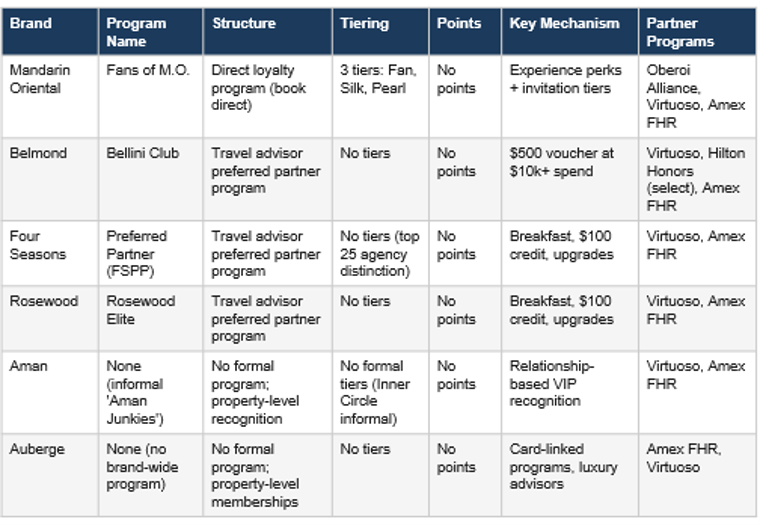
The table below provides a structured comparison of each brand's loyalty architecture across key dimensions.
3.1 Program Structure Overview
3.2 Benefit-by-Benefit Comparison
The following matrix compares the specific benefits available to guests of each brand through their primary loyalty or preferred partner mechanism.
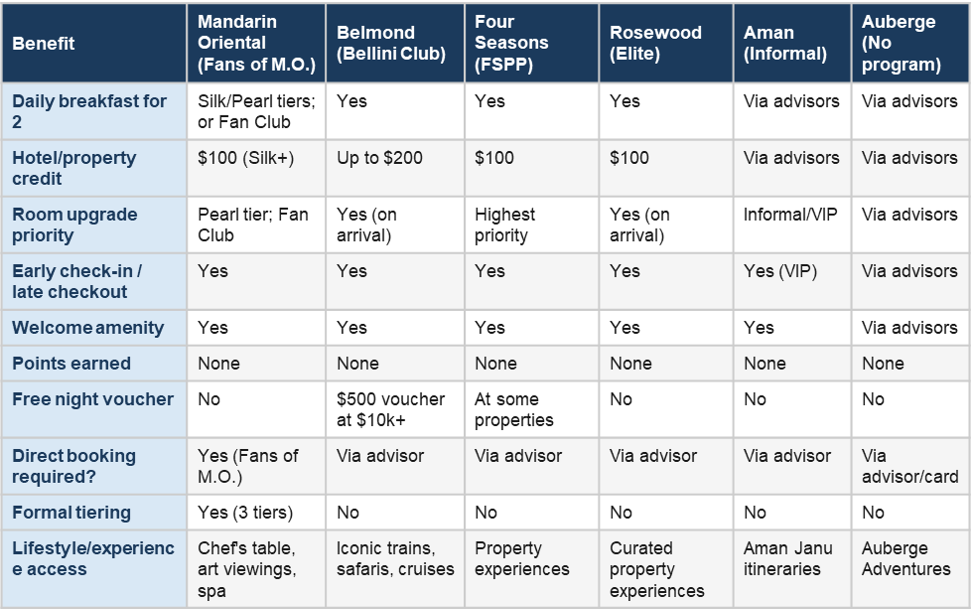
Note on 'Advisor vs. Direct': Most brands in this analysis deliver their best benefits through travel advisors rather than direct booking. The exception is Mandarin Oriental, where the Fans of M.O. program explicitly requires direct booking on mandarinoriental.com and excludes third-party channels. This creates a direct conflict between the brand's best advisor program (Fan Club) and its direct loyalty program — guests must choose one or the other.
Section 4: Strategic Partnerships and Third-Party Integrations
The advisor ecosystem and credit card partnerships that underpin loyalty in this segment deserve dedicated analysis, as they function as a de facto loyalty infrastructure for brands that lack proprietary points programs.
4.1 Virtuoso: The Premier Luxury Travel Advisor Network
Virtuoso is the most important single relationship in luxury hotel loyalty. This invitation-only network of approximately 20,000 luxury travel advisors has partnership agreements with all six brands in this analysis — though the depth of benefits varies. Through Virtuoso, guests typically receive breakfast for two, a hotel credit, room upgrade consideration, and early check-in/late checkout.
The key distinction among brands is how Virtuoso ranks against their own preferred partner programs. For Four Seasons, Virtuoso benefits rank below FSPP upgrade priority, meaning an FSPP booking delivers better room allocation. For Mandarin Oriental, Fans of M.O. Fan Club (their preferred partner program) explicitly outperforms the Virtuoso benefit set and cannot be combined. For Belmond, Virtuoso and Bellini Club benefits at most properties are mutually exclusive — guests must choose.
4.2 American Express Fine Hotels + Resorts (Amex FHR)
The American Express Fine Hotels + Resorts program, available to Platinum Card holders, is the largest single channel through which affluent travelers access luxury hotel benefits without using a travel advisor. Amex FHR benefits — breakfast for two, $100 credit, guaranteed 4pm late checkout, noon check-in when available, and a property-specific amenity — are available at all six brands in this analysis.
Amex FHR's unique advantage is the guaranteed 4pm late checkout, which is stronger than the 'subject to availability' late checkout offered by most preferred partner programs. This is a material differentiator for guests who value schedule flexibility over other perks. However, Amex FHR upgrade priority is typically below Four Seasons Preferred Partner priority, and Amex FHR benefits cannot be combined with FSPP bookings at Four Seasons.
4.3 Credit Card Points Integration
Unlike mainstream luxury chains such as Marriott or Hyatt, none of the six brands in this analysis operate co-branded credit cards or direct points transfer partnerships with consumer credit cards. Guests cannot earn brand-specific points on hotel stays through a credit card, nor can they redeem credit card points for stays through a brand portal.
However, stay costs at all six brands can be booked via credit card travel portals (Chase Travel, Amex Travel, Citi Travel) allowing the use of Ultimate Rewards, Membership Rewards, or ThankYou Points to pay for stays at face value. This is a meaningful workaround for points-focused travelers, though it typically requires booking through the portal (losing advisor benefits) and earns points at base portal rates rather than category-specific bonus rates.
Belmond's participation in Hilton Honors at select properties represents the only formal integration between any of these brands and a major mainstream loyalty currency. At participating Belmond hotels, Bellini Club bookings earn double Hilton Honors base points.
4.4 Mandarin Oriental's O&MO Alliance
The most structurally significant brand-to-brand partnership in this cohort is Mandarin Oriental's O&MO Alliance with Oberoi Hotels & Resorts. This cross-recognition agreement allows Fans of M.O. members to carry their recognition status across both brands — potentially a powerful proposition for guests who travel extensively in India, Egypt, and Southeast Asia, where Oberoi's footprint complements Mandarin Oriental's. This represents the most advanced loyalty partnership architecture among the six brands.
Section 5: Experience-Based Rewards and Differentiation
In the ultra-luxury segment, the most meaningful reward is not a free night or a flight upgrade — it is access to experiences that money cannot straightforwardly buy. Each brand has developed its own version of this experiential currency, and these distinctions are arguably more strategically important than the transactional benefit comparisons in Section 3.
5.1 Mandarin Oriental: Craft and Culture
Mandarin Oriental's Fans of M.O. program is built around what the brand calls 'masters of craft' — the chefs, spa therapists, and wellness practitioners at its properties who deliver experiences unavailable elsewhere. Pearl tier benefits include by-invitation-only art viewings, intimate Chef's table suppers in private settings, and access to cultural experiences curated by each property. The brand explicitly frames these not as loyalty rewards but as deeper access to the brand's human talent.
The 10% ShopMO discount for members and the EUR 300 concierge credit on villa bookings extend the experiential proposition into lifestyle and accommodation categories beyond the hotel stay itself.
5.2 Belmond: The Iconic Journey
Belmond's experiential advantage is structural and unreplicable: the Venice Simplon-Orient-Express. A journey on the VSOE — through the Alps from London to Venice in restored 1920s and 1930s carriages, with a Belmond chef preparing dinner service in the dining car — is not a 'perk' that can be replicated by breakfast credits or room upgrades. It is a transformative travel experience in its own right. That loyal Belmond guests can access this journey within the same advisor relationship as their hotel stays, and earn the $500 gift voucher toward it, creates a loyalty loop that reinforces the entire Belmond ecosystem.
The expanding portfolio of iconic train journeys — Royal Scotsman through the Scottish Highlands, Andean Explorer across Peru, British Pullman through the English countryside — combined with river cruises and safari properties means that Belmond's experiential offer is truly multimodal. Loyal guests can design an annual travel plan that spans trains, boats, lodges, and city hotels, all under one Bellini Club relationship.
5.3 Aman: Itinerary Architecture
Aman's experiential product is its properties themselves. The brand has developed a series of multi-property itinerary programs in destination clusters — Aman Japan (three properties across Tokyo, Kyoto, and the Japanese countryside), Aman Bali (multiple properties enabling a full cultural immersion), and Aman Bhutan (a Buddhist kingdom journey across five properties) — that reward long-term brand loyalty with a coherent multi-property travel narrative. These journeys often include exclusive inclusions — private temple access in Bhutan, insider cultural programming in Japan — that are not available outside the Aman relationship.
5.4 Four Seasons: Private Jet and Residences
Four Seasons has invested heavily in lifestyle extensions that deepen brand loyalty beyond individual hotel stays. The Four Seasons Private Jet Experience — a series of curated around-the-world journeys on a branded aircraft, carrying approximately 48 guests — is one of the most exclusive products in luxury travel and creates a loyal community of repeat guests who return year after year. Four Seasons Residences (branded private homes in approximately 80 locations worldwide) create perhaps the deepest possible loyalty relationship: guests who own a Four Seasons residence are essentially permanent community members of the brand.
5.5 Auberge: Adventures Programming
Auberge has invested in proprietary experiential programming it calls 'Auberge Adventures' — curated outdoor and cultural experiences that leverage each property's natural setting. From lava tube exploration in Hawaii to truffling in Napa to backcountry skiing in Utah, these programs offer authentic place-based experiences that differentiate the brand. However, without a loyalty architecture to anchor repeat guests to this programming, Auberge cannot yet build the same depth of experiential loyalty relationship as its more established competitors.
Section 6: Where the Programs Diverge — Key Differentiators
Having examined each brand individually, this section synthesizes the most strategically significant differences among the six approaches.
6.1 The Only Brand with Real Tiers: Mandarin Oriental
Mandarin Oriental is the only brand in this analysis with a formal, tiered, publicly available guest recognition program. Every other brand either has no program at all (Aman, Auberge) or routes recognition entirely through advisor-mediated preferred partner programs (Four Seasons, Rosewood, Belmond). This is a structural first-mover advantage that positions Mandarin Oriental to build deeper direct digital relationships with guests while competitors depend on intermediaries.
The deliberate opacity of Silk and Pearl qualification criteria — combined with the app-mediated recognition experience — creates a modern aspiration architecture that mirrors how luxury fashion brands manage their highest-tier client relationships. It is the most sophisticated loyalty strategy in this segment.
6.2 The Highest Loyalty Purity: Aman
Aman represents the extreme end of the 'experience over transaction' philosophy. While every other brand in this analysis uses some version of structured benefits (breakfast, credits, upgrades) to operationalize loyalty, Aman's loyalty is entirely experiential and relational. The 'Aman Junkie' community functions without any formal infrastructure and yet delivers retention rates that brand marketing professionals describe as among the highest they have seen in any consumer category. For a brand where the average stay cost is $2,000-$8,000 per night, even a modest repeat visit rate has enormous revenue implications.
6.3 The Most Comprehensive Experience Ecosystem: Belmond
No brand in this analysis can match Belmond's multi-modal experiential offer. The ability to connect hotel stays, legendary train journeys, river cruises, and safaris under a single Bellini Club booking relationship — and to earn the $500 voucher across all of these categories — creates a loyalty stickiness that is architectural rather than programmatic. Belmond guests are not loyal to hotels; they are loyal to the art of travel itself.
6.4 The Biggest Loyalty Gap: Auberge
Auberge Resorts Collection's complete absence of any brand-level loyalty recognition is its most significant strategic vulnerability. As the brand grows toward 50 properties, it will increasingly compete for the same guests as Four Seasons, Rosewood, and Mandarin Oriental — all of which can offer meaningful recognition for cross-property loyalty. A guest who has stayed at Auberge du Soleil, Mauna Lani, and Malliouhana has no mechanism through which Auberge can recognize, reward, or even identify that relationship at a brand level. This gap becomes more commercially costly with every new property opening.
6.5 The Scale-Loyalty Tension: Four Seasons and Rosewood
Four Seasons and Rosewood face a shared tension: their rapid portfolio expansion creates scale that makes the purely relational, property-level recognition models of Aman increasingly impractical, while their luxury positioning makes the points-and-tiers mechanics of Marriott or Hilton philosophically incompatible. Both brands have resolved this tension by delegating loyalty infrastructure entirely to the advisor community — but this means that guests who book direct (increasingly the preferred channel for many luxury travelers) receive no formal recognition.
Rosewood's aggressive pipeline growth in particular — from 31 to potentially 55 properties by 2028 — will test whether the Rosewood Elite advisor program can scale without becoming diluted. The brand's entry into mass-luxury Middle Eastern resort markets also introduces a guest profile (high-frequency domestic Gulf travelers) that may be more receptive to formal loyalty mechanics than Rosewood's traditional Western leisure clientele.
Section 7: Future Directions and Announced Developments
The luxury hotel loyalty landscape is not static. Several significant developments have been announced or signaled that will shape this segment over the next two to three years.
7.1 Mandarin Oriental: App Expansion and Digital Loyalty
Mandarin Oriental has publicly committed to expanding its first-ever mobile app's capabilities. Currently offering itinerary management, stay history, privilege viewing, and in-app concierge chat, the app roadmap includes in-app checkout, payment, and further personalization features. The brand has signaled that the app will become the primary engagement channel for Silk and Pearl members — a digital-first loyalty relationship architecture that is unprecedented at this price point.
The O&MO Alliance with Oberoi is also expected to deepen, potentially extending cross-recognition to additional mutual benefits beyond the current baseline. An expansion of partner benefits through the ShopMO platform and the curated villa partnership further broadens what 'loyalty' means in the Mandarin Oriental context.
7.2 Belmond: LVMH Integration and Orient Express Expansion
LVMH's strategic investment in the Accor-led Orient Express brand revival — where LVMH is contributing Belmond's train expertise — opens the possibility of future loyalty linkages between Belmond's Bellini Club and the Orient Express ecosystem. While no formal cross-loyalty announcement has been made as of this writing, LVMH's option to acquire full control of the Orient Express brand by 2027 makes eventual integration a strategic question rather than a remote possibility.
Belmond's own train portfolio is expanding: the British Pullman and a new Britannic Explorer are among developments cited for 2025 and beyond. Each new train and cruise product deepens the Bellini Club's multi-modal value proposition.
7.3 Rosewood: Loyalty Program Speculation
Rosewood has not announced any plans to launch a formal loyalty program. However, industry observers consistently note that its rapid scale expansion — and the increasing presence of Rosewood properties in markets where loyalty programs drive booking behavior — makes this a medium-term strategic question rather than a philosophical one. The StatusMatch platform currently lists Rosewood Hotels on a waitlist for status matching, suggesting industry anticipation that a program may be forthcoming.
7.4 Aman: Janu as a Loyalty Funnel
Aman's launch of Janu — its sister brand targeting a more accessible price point and a more social guest profile — has been interpreted by analysts as a potential loyalty funnel: an entry point through which guests can enter the Aman ecosystem at slightly lower price points before graduating to full Aman properties. The Janu Tokyo opened in early 2024, with further properties planned in AlUla and Diriyah, Saudi Arabia. Travel advisors with Aman preferred partner status can apply Virtuoso-tier benefits at Janu properties, creating a seamless booking relationship across both brands.
7.5 Auberge: Potential Program Launch
Multiple industry sources suggest that Auberge Resorts Collection is actively exploring the development of a brand-wide loyalty or recognition program, though no formal announcement has been made. The brand's growing scale, its expansion into European markets (where guest recognition programs are increasingly expected even at ultra-luxury price points), and the competitive pressure from more loyalty-sophisticated peers all point toward eventual action. Any Auberge program would likely follow the experiential, recognition-based model of Mandarin Oriental rather than the points-based mechanics of mainstream chains.
Section 8: Conclusion — Why Luxury Loyalty Is Fundamentally Different
Having examined the loyalty architectures of six leading ultra-luxury hotel brands, we can now draw broader conclusions about what distinguishes this segment from the mainstream hotel loyalty landscape.
8.1 The Transactional Paradox
The most striking observation from this analysis is that the brands with the highest guest retention rates — Aman above all, but also Mandarin Oriental and Belmond — are also the brands that have most aggressively rejected transactional loyalty mechanics. Marriott Bonvoy has 228 million members and an elaborate five-tier structure. Hilton Honors has 210 million members and is growing faster than any other hotel program. Both deploy points, multipliers, co-branded credit cards, and retail partnerships to engineer 'loyalty' at scale.
Aman, with 36 properties and no loyalty program, commands a level of guest devotion that those platforms can only approximate. The explanation lies in what economists call 'switching costs': for a mainstream hotel guest, the switching cost of moving from Marriott to Hilton is relatively low, so loyalty programs exist to artificially raise that cost through point accumulation and status investment. For an Aman guest, there is no Hilton equivalent — no other brand delivers what Aman delivers, which makes the switching cost structurally infinite.
8.2 Recognition Over Reward
The dominant philosophy in ultra-luxury hotel loyalty is recognition over reward. Where mainstream programs offer points redeemable for free nights or upgrades, luxury programs offer the experience of being known, anticipated, and treated as an individual rather than a status tier. This distinction matters enormously to the guest profile in question: high-net-worth individuals for whom the financial value of a 10,000-point bonus is irrelevant, but for whom being greeted by name, having their dietary preferences pre-remembered, and receiving a personalized welcome amenity is genuinely meaningful.
The advisor-mediated preferred partner programs that dominate this segment — Bellini Club, FSPP, Rosewood Elite — are essentially institutionalized recognition delivery systems. The advisor relationship encodes the guest's preferences, communicates them to the hotel in advance, and ensures the hotel team has the context to deliver a personalized experience from the moment of arrival. This is a sophisticated loyalty mechanism; it is simply not structured like one.
8.3 Scarcity as Loyalty Engineering
Mainstream loyalty programs are designed to be accessible. The entire architecture of Marriott Bonvoy, Hilton Honors, and World of Hyatt is predicated on inclusivity — the more members, the more data, the more co-branded card spending, the more revenue. The programs in this analysis are designed for scarcity. Aman's Inner Circle is not published. Mandarin Oriental's Pearl tier has no stated qualification criteria. Belmond's Bellini Club has fewer than 100 certified agencies. Four Seasons' Top 25 Global Advisors are, by definition, 25 agencies.
This is deliberate. In a market where the luxury proposition is built on exclusivity, a recognition program that is visible to and achievable by everyone would undermine the very brand values it is meant to reinforce. The result is a loyalty architecture that mirrors the structure of private membership clubs rather than consumer points programs — which is precisely the register in which the most valuable ultra-luxury guests prefer to be engaged.
8.4 Experience as Currency
The most enduring loyalty currencies in this segment are not points or nights — they are the memories that guests carry from Aman Bhutan, the Venice Simplon-Orient-Express, or a private Chef's table dinner at Mandarin Oriental. These experiences are irreproducible, deeply personal, and functionally impossible for a competitor to replicate or 'match.' A Marriott Bonvoy point is a commodity; a Belmond train journey is a story a guest will tell for the rest of their life.
This is not a new insight in hospitality strategy, but its implications for loyalty program design are profound. The ultra-luxury brands that are winning on long-term retention are those that invest most heavily in the experiential quality of the stay itself — not in the mechanics of how that stay is rewarded. Mandarin Oriental's new Silk and Pearl tiers work precisely because what they unlock is not a free night but a chef, an art collector, and a story.
8.5 The Advisor as Loyalty Infrastructure
Perhaps the least-analyzed aspect of luxury hotel loyalty is the role of the travel advisor community as a de facto loyalty management layer. By routing recognition through invitation-only advisor networks, brands like Four Seasons, Rosewood, and Belmond have outsourced the operational complexity of loyalty program management to a network of highly motivated, high-touch human agents. These advisors maintain guest preference profiles, communicate with hotels in advance, advocate for their clients in allocation decisions, and manage the guest relationship across multiple stays and brands.
This model has significant advantages: it scales without the technology infrastructure of a points platform, it delivers a level of personalization that no digital program can match, and it aligns the interests of the advisor (a successful stay leads to repeat bookings) with those of the brand and the guest. Its disadvantage is that it is entirely intermediated — brands that rely on it have no direct loyalty relationship with their guests and no direct data on guest behavior across the portfolio.
Mandarin Oriental's decision to build a direct digital loyalty channel through the Fans of M.O. app is a recognition that this intermediated model has long-term limitations in data and relationships. It may prove to be the loyalty innovation that defines the next decade of ultra-luxury hospitality.
Final Observation: The brands in this analysis have collectively defined a new paradigm for loyalty in experiential luxury — one that replaces the earn-and-burn mechanics of mass hospitality with a philosophy of earned access, human recognition, and experiential rarity. As AI-driven personalization becomes more sophisticated and luxury travelers' expectations for seamless, predictive service continue to rise, the brands that can most fluently combine the warmth of human recognition with the precision of digital personalization will define the next era of ultra-luxury loyalty. Mandarin Oriental's 2025 relaunch suggests the race has already begun.